In competitive B2B markets, most companies focus on improving their product, sharpening pricing, or refining their pitch. But what often determines who wins isn’t what’s being sold it’s how the story is framed. Buyers rarely evaluate vendors in a neutral vacuum. They evaluate within a narrative. If you don’t control that narrative, your competitor will. Narrative control is the ability to define the problem, shape the criteria, and position your solution as the logical conclusion. When done right, it shifts the entire evaluation in your Favor before comparisons even begin.
-
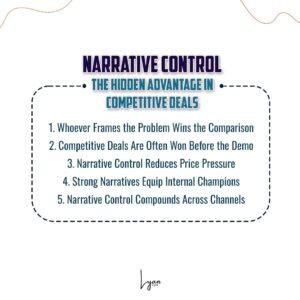
Whoever Frames the Problem Wins the Comparison
When buyers define the problem on their own, they set the evaluation criteria. But when you reframe the problem strategically, you influence how success is measured.
If the problem is framed as “cost reduction,” you compete on price.
If it’s framed as “revenue predictability,” you compete on impact.
Narrative framing determines what buyers prioritize.
Key Insights:
- Problem framing shapes evaluation criteria.
- Control the lens, and you influence the outcome.
- Strategic reframing reduces direct competition.
-
Competitive Deals Are Often Won Before the Demo
By the time a buyer sees your product, they already carry assumptions about what matters.
If your messaging, content, and positioning have already influenced how they think about the category, you enter the demo with an advantage.
Without narrative control, you’re reacting to criteria set by someone else.
Key Insights:
- Pre-demo perception shapes deal direction.
- Thought leadership influences buyer mindset.
- Early narrative exposure reduces friction later.
-
Narrative Control Reduces Price Pressure
When buyers compare vendors feature-for-feature, pricing becomes central. But when you reshape the conversation around a differentiated approach or philosophy, the comparison becomes harder to simplify.
Complex, well-framed narratives reduce price-based decisions because buyers struggle to compare apples to apples.
Key Insights:
- Strategic framing increases pricing flexibility.
- Unique positioning reduces commoditization.
- Narrative depth limits surface-level comparisons.
-
Strong Narratives Equip Internal Champions
In enterprise deals, your contact must often defend the decision internally.
If your narrative is clear and compelling, your champion can easily explain:
- Why this approach matters
- Why it’s different
- Why it’s safer
Without narrative clarity, internal advocacy weakens.
Key Insights:
- Clear storytelling empowers internal defenders.
- Simplicity improves memorability.
- Advocacy depends on narrative clarity.
-
Narrative Control Compounds Across Channels
Your website, content, sales decks, case studies, and demos must all reinforce the same strategic story. Inconsistent messaging weakens narrative control and creates doubt.
When every touchpoint supports the same framing, buyers experience consistency — and consistency builds trust.
Key Insights:
- Consistency strengthens perception.
- Unified storytelling accelerates decisions.
- Repetition reinforces positioning.

How Lyan.digital Helps You Own the Narrative
At Lyan.digital, we help B2B companies design and control their market narrative. We analyze competitive positioning, identify framing opportunities, align messaging across marketing and sales, and structure thought leadership that influences buyer perception before formal engagement begins.
The objective isn’t just to compete better it’s to compete differently.
Frequently Asked Questions
Is narrative control manipulation? No. It’s strategic clarity. You’re guiding how the problem is understood, not misleading buyers.
Can narrative control shorten sales cycles? Yes. When buyers adopt your framing early, evaluation becomes smoother.
Does this apply to small businesses? Absolutely. Strategic framing benefits companies of all sizes.
Should narrative differ across industries? Yes. Industry context affects how problems are perceived.
How long does it take to influence narrative perception? It can begin immediately but compounds over consistent messaging.
Does narrative control replace product strength? No. It amplifies strong products and weakens competitive pressure.
Can multiple narratives confuse buyers? Yes. A single clear strategic story performs better.
Here’s How This Helps
- A SaaS company reframed its category from “automation software” to “revenue acceleration infrastructure.” Enterprise buyers began evaluating impact rather than feature parity.
- A cybersecurity vendor shifted the conversation from threat detection tools to regulatory risk mitigation. Procurement teams responded faster because the narrative aligned with compliance priorities.
- A B2B services firm positioned itself as a strategic transformation partner instead of a project-based consultant. Deal sizes increased due to perceived long-term value.
- An analytics platform unified its website and sales messaging around executive visibility rather than dashboards. Internal champions found it easier to justify the purchase.
In competitive deals, you’re not just selling a solution.
You’re shaping how the problem is understood.
When you control the narrative, you reduce friction, influence criteria, and increase strategic advantage.
The company that defines the story often wins the deal.