By the time most B2B vendors realize they’re being evaluated, they’re already competing in a shortlist. And by then, half the battle has already been decided.
Enterprise buyers rarely evaluate dozens of vendors deeply. They narrow quickly. Sometimes silently. Sometimes before you even know you were considered. Shortlisting isn’t random it’s psychological.
It’s influenced by clarity, authority, familiarity, perceived safety, and narrative alignment. If you understand how buyers mentally filter vendors before formal engagement, you can position yourself to be chosen earlier and more often.
-
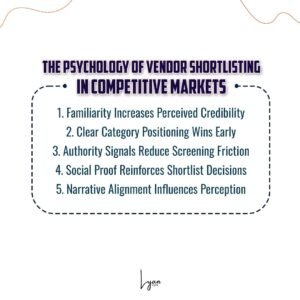
Familiarity Increases Perceived Credibility
Buyers shortlist vendors they’ve seen before.
That visibility might come from:
- Thought leadership
- Referrals
- Industry mentions
- Consistent content
When your brand feels familiar, it feels safer. And safety is a powerful filter.
Key Insights:
- Familiarity builds comfort.
- Consistent presence increases recall.
- Visibility precedes evaluation.
-
Clear Category Positioning Wins Early
If buyers struggle to understand what you do, they won’t shortlist you.
Clarity helps buyers quickly decide:
“Yes, this is relevant.”
Ambiguity creates hesitation, and hesitation often removes you from consideration.
Key Insights:
- Clarity accelerates inclusion.
- Confusion reduces shortlist probability.
- Simple positioning performs better.
-
Authority Signals Reduce Screening Friction
Buyers often shortlist vendors who appear authoritative.
Authority signals include:
- Clear frameworks
- Strong points of view
- Recognizable client proof
- Structured messaging
When expertise is obvious, evaluation feels easier.
Key Insights:
- Authority increases trust.
- Clear thought leadership improves selection likelihood.
- Expertise reduces scepticism.
-
Social Proof Reinforces Shortlist Decisions
Buyers look for reassurance that others have safely chosen you.
Industry-specific case studies, testimonials, and recognizable logos all strengthen shortlisting probability.
It’s not about showing quantity it’s about showing relevance.
Key Insights:
- Relevance matters more than volume.
- Similar use cases increase confidence.
- Peer validation reduces doubt.
-
Narrative Alignment Influences Perception
If your messaging aligns with how buyers internally define their problem, you move from “option” to “fit.”
Shortlisting happens when buyers feel:
“They understand our situation.”
Alignment isn’t about volume. It’s about resonance.
Key Insights:
- Resonance drives inclusion.
- Messaging alignment increases relevance.
- Strategic framing influences filtering.
How Lyan.digital Improves Shortlist Probability
At Lyan.digital, we help B2B companies strengthen early-stage perception. We refine positioning, enhance authority signals, build narrative alignment, and structure content ecosystems that increase familiarity and trust before formal evaluation begins.
The goal isn’t just to compete well it’s to compete earlier.
Frequently Asked Questions
Can we influence shortlisting before direct contact? Yes. Strategic visibility and positioning shape perception early.
Does SEO affect shortlisting? Yes. Ranking for relevant problem-focused keywords increases familiarity.
Is branding important in enterprise markets? Absolutely. Recognition reduces uncertainty.
How do we increase authority perception? Through clear frameworks, proof assets, and consistent messaging.
Does pricing influence shortlisting? Not initially. Perceived fit and safety matter more.
Can small companies get shortlisted against large brands? Yes, if positioning is sharp and authority signals are strong.
What’s the biggest shortlist mistake? Inconsistent messaging that weakens perceived clarity.
Here’s How This Helps
- A SaaS company invested in consistent thought leadership aligned with industry pain points. It began appearing in shortlists without direct outreach.
- A cybersecurity vendor clarified category positioning and added compliance case studies. Shortlist inclusion increased significantly.
- A B2B automation firm strengthened website clarity and proof layers. Enterprise buyers began engaging earlier in the evaluation process.
- An analytics platform unified its messaging around executive-level insights, improving shortlist consistency across competitive deals.
Final Thoughts
Shortlisting doesn’t begin at the demo.
It begins long before in perception, clarity, familiarity, and trust.
If you want to win more competitive deals,
don’t just improve your pitch.
Improve your probability of being considered.