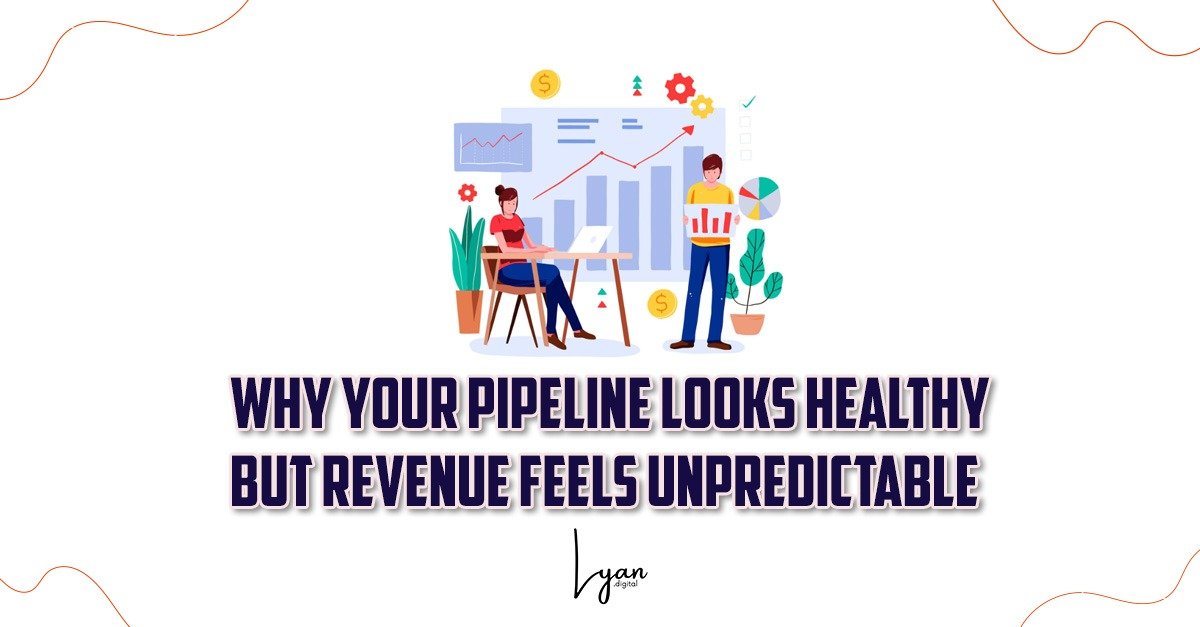
On paper, everything looks strong. There are leads in the CRM, deals in progress, demos booked, proposals sent. The pipeline dashboard feels active and reassuring. Yet when quarter-end approaches, revenue becomes uncertain. Forecasts fluctuate. Deals slip. Confidence drops.
This disconnect happens more often than teams admit. A full pipeline doesn’t automatically translate into predictable revenue. Volume can create the illusion of progress while hiding weak intent, misaligned messaging, or fragile positioning.
If revenue feels unpredictable despite pipeline activity, the issue isn’t traffic. It’s structure.
-
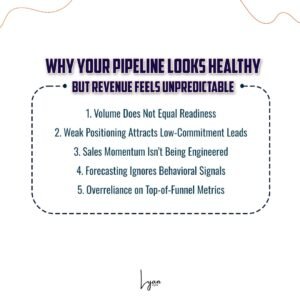
Volume Does Not Equal Readiness
Many pipelines are filled with early-stage curiosity rather than buying intent. Interest is logged as opportunity. Conversations are counted as progress.
But not all leads are equally prepared to move forward.
When buyer readiness isn’t qualified properly, forecasts become unstable.
Key Insights:
- Activity is not the same as intent.
- Readiness determines predictability.
- Qualification depth affects revenue stability
-
Weak Positioning Attracts Low-Commitment Leads
If your messaging is broad, it attracts wide interest but not necessarily serious buyers.
When positioning lacks sharpness, your funnel fills with:
- Explorers
- Researchers
- Budget-less prospects
These inflate pipeline numbers but reduce close probability.
Key Insights:
- Broad messaging increases noise.
- Sharp positioning filters better.
- Relevance improves close rates.
-
Sales Momentum Isn’t Being Engineered
Many teams rely on follow-ups and reminders rather than structured progression.
Without clear next steps, internal justification support, and decision-enablement assets, deals drift.
Revenue predictability requires intentional momentum.
Key Insights:
- Structure reduces deal slippage.
- Clear milestones support progression.
- Momentum must be designed
-
Forecasting Ignores Behavioral Signals
Pipeline stages alone don’t reveal intent strength.
Behavioral signals matter:
- Repeat visits to pricing pages
- Engagement with comparison guides
- Executive involvement
- Short response windows
Ignoring these signals makes revenue appear random.
Key Insights:
- Behavioral data improves forecast accuracy.
- Engagement depth signals seriousness.
- Intent tracking stabilizes predictions.
-
Overreliance on Top-of-Funnel Metrics
Many teams celebrate lead generation numbers without evaluating mid-funnel strength.
If awareness grows but evaluation assets are weak, pipeline inflates but conversion stalls.
Predictable revenue requires strength across the entire buyer journey.
Key Insights:
- Funnel balance determines reliability.
- Mid-funnel content impacts close rates.
- Depth matters more than reach.
How Lyan.digital Stabilizes Revenue Through Strategic Architecture
At Lyan.digital, we design pipeline systems that prioritize intent over volume. We refine positioning, implement behavioral tracking, align messaging with readiness stages, and structure progression assets that reduce slippage.
The result isn’t just more leads it’s clearer, steadier revenue movement.
Frequently Asked Questions
Why does pipeline growth not guarantee revenue growth? Because lead quality and buyer readiness determine conversion.
How can we improve forecast accuracy? Incorporate behavioral intent signals into qualification.
Should we reduce top-of-funnel activity? Not necessarily but it must align with mid-funnel strength.
Can better messaging increase predictability? Yes. Sharper positioning filters high-fit buyers.
What’s the biggest forecasting mistake? Treating all pipeline stages as equal.
Does sales enablement affect predictability? Yes. Clear decision support reduces deal drift.
Can content influence revenue stability? Absolutely. Structured content reduces uncertainty.
Here’s how it helps
- A SaaS company refined its qualification criteria and saw pipeline numbers shrink but revenue stability improves significantly.
- A cybersecurity vendor introduced behavioral tracking for pricing page revisits. Forecast accuracy improved across two quarters.
- A B2B automation firm strengthened mid-funnel content and internal justification assets. Deal slippage decreased noticeably.
- An analytics platform aligned messaging with buyer readiness stages, resulting in more consistent quarterly revenue.
A full pipeline can feel reassuring. But without intent clarity, structured progression, and strong positioning, revenue remains unpredictable.
Revenue doesn’t become stable by increasing volume.
It becomes stable by increasing precision.
When readiness improves, predictability follows.