You’ve heard it before.
The call goes well. No tension. No objections.
Everything feels… smooth.
And then they say it:
“Let me think about it.”
Not a no.
Not a yes either.
Just… a pause.
You nod. Say something polite. Maybe even feel like it’s still a good sign.
But deep down, you know something just slipped.
Because most of the time,
“let me think about it” doesn’t lead to a decision.
It leads to distance.
And here’s the truth
they’re not asking for time.
They’re buying space.
-
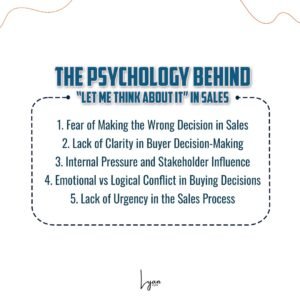
Fear of Making the Wrong Decision in Sales
Nobody wants to be the person who chose wrong.
Especially in B2B, where decisions are visible, questioned, and sometimes judged.
So even if your solution makes sense, there’s still that quiet hesitation:
“What if this doesn’t work the way I expect?”
Instead of saying that out loud, they take the safer route.
They think.
Or at least… say they will.
Key Insight:
“Let me think about it” is often fear just phrased politely.
-
Lack of Clarity in Buyer Decision-Making
Sometimes, the problem isn’t doubt.
It’s fog.
They understand parts of what you said.
But not enough to feel settled.
Something is still unclear:
- how this actually plays out
- what happens after they say yes
- how different this is from other options
And when clarity is incomplete, thinking feels necessary.
Key Insight:
People don’t delay decisions they fully understand.
-
Internal Pressure and Stakeholder Influence
Even if the person you’re speaking to is convinced…
they’re not the only voice in the room.
They’re already thinking ahead:
“What will my boss say?”
“How do I explain this to my team?”
And if they don’t have a clean way to present it internally,
they hesitate.
So instead of committing, they step back.
Not because they’re unsure
but because they’re not ready to carry the decision forward.
Key Insight:
If they can’t explain your solution internally, they won’t move externally.
-
Emotional vs Logical Conflict in Buying Decisions
On one side, it makes sense.
On the other, something doesn’t feel fully settled.
That’s the internal conflict.
Logic says yes.
Emotion says… wait.
And when those two don’t match, people don’t decide.
They pause.
Because thinking feels like progress
even when it’s actually avoidance.
Key Insight:
Decisions happen when logic and emotion agree not when one convinces the other.
-
Lack of Urgency in the Sales Process
This is the quiet killer.
They don’t feel pressure.
They don’t feel loss.
They don’t feel like waiting changes anything.
So they say:
“Let me think about it.”
Not as an excuse
but because nothing is pushing them to act now.
And without urgency, decisions drift.
Key Insight:
When nothing feels at stake, thinking replaces action.
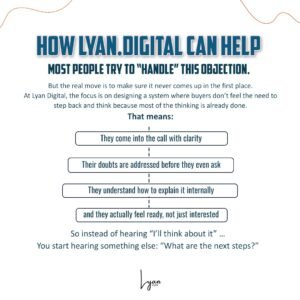
How Lyan.digital Can Help
Most people try to “handle” this objection.
But the real move is to make sure it never comes up in the first place.
At Lyan Digital, the focus is on designing a system where buyers don’t feel the need to step back and think because most of the thinking is already done.
That means:
- they come into the call with clarity
- their doubts are addressed before they even ask
- they understand how to explain it internally
- and they actually feel ready, not just interested
So instead of hearing “I’ll think about it” …
You start hearing something else:
“What are the next steps?”
Real-Life Scenarios
A founder kept hearing “let me think about it” after every strong sales call. The issue wasn’t the pitch buyers didn’t fully understand what would happen after signing.
A B2B agency noticed prospects showing high interest but delaying decisions. The gap? Clients couldn’t clearly explain the value internally.
A consultant had great conversations but low conversions. Once they simplified how the offer was communicated, the “thinking” phase almost disappeared.
Frequently Asked Questions
Is “let me think about it” a rejection? Not always. It usually means something is incomplete not necessarily wrong.
Should I push harder when I hear this? No. Pressure increases resistance. Clarity reduces hesitation.
What’s the real reason behind this response? Fear, lack of clarity, or inability to justify the decision internally.
How do I avoid this objection? By making the decision clearer before the buyer reaches that point.
Does this mean the buyer isn’t serious? Not at all. Many serious buyers say this when they’re not fully ready.
“Let me think about it” sounds harmless.
But it’s rarely neutral.
It’s a signal.
Something isn’t fully clear.
Something doesn’t feel complete.
Something is still holding them back.
And until that’s resolved, thinking becomes the default.
But when the decision feels clear, safe, and easy to stand behind
They don’t step back.
They step forward.