Some companies chase attention. Others command respect.
The difference isn’t budget. It isn’t brand size. It isn’t even product quality.
It’s authority.
When buyers perceive authority, the sales process feels smoother. Fewer objections. Shorter explanations. Less scepticism. Pricing conversations become easier. Authority changes the energy of a deal.
You stop convincing.
You start guiding.
This blog explores how strategic messaging builds authority and how that authority quietly reduces friction across the entire sales cycle.
-
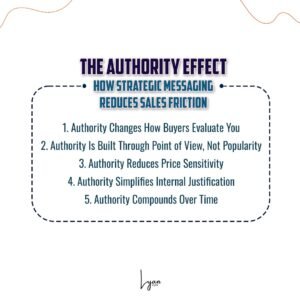
Authority Changes How Buyers Evaluate You
When buyers see you as a vendor, they evaluate.
When buyers see you as an authority, they listen.
Authority shifts the mindset from:
“Prove yourself.”
To:
“Teach me.”
This shift reduces friction instantly. Buyers don’t interrogate authorities they seek clarity from them.
Key Insights:
- Authority reframes the sales dynamic.
- Experts are questioned less than vendors.
- Perceived leadership increases trust.
-
Authority Is Built Through Point of View, Not Popularity
Many brands think authority comes from social proof alone.
But authority begins with conviction.
A strong, clear perspective signals depth.
If your messaging sounds neutral, safe, or overly agreeable, you blend in. Real authority takes a stance. It challenges assumptions. It reframes problems.
When buyers sense you understand the landscape deeply, resistance lowers.
Key Insights:
- Clear positioning signals expertise.
- Strong opinions create memorability.
- Neutral messaging weakens impact.
-
Authority Reduces Price Sensitivity
When you are perceived as one of many options, price becomes the easiest comparison point.
But when buyers view you as a category leader or specialist, the conversation changes.
They compare risk, not cost.
They compare certainty, not discounts.
Authority increases margin tolerance because buyers associate it with lower failure probability.
Key Insights:
- Authority increases pricing leverage.
- Buyers pay more for perceived certainty.
- Strategic positioning reduces discount pressure.
-
Authority Simplifies Internal Justification
Enterprise buyers rarely decide alone.
They must defend their choice internally.
If you’re messaging clearly communicates:
- Why you’re different
- Why your approach works
- Why it reduces risk
Your internal champion can confidently advocate for you.
Authority isn’t just external influence. It’s internal defensibility.
Key Insights:
- Authority equips internal advocates.
- Clear narratives ease committee decisions.
- Confident messaging reduces political friction.
-
Authority Compounds Over Time
Authority doesn’t spike it compounds.
Consistent thought leadership.
Clear category positioning.
Repeated strategic messaging.
Over time, buyers begin to associate your brand with expertise automatically.
And when recognition exists before the first call, half the friction is already removed.
Key Insights:
- Authority grows through consistency.
- Repetition builds recognition.
- Familiarity strengthens credibility.
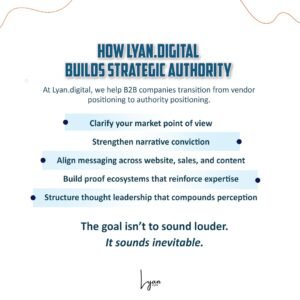
How Lyan.digital Builds Strategic Authority
At Lyan.digital, we help B2B companies transition from vendor positioning to authority positioning.
We:
- Clarify your market point of view
- Strengthen narrative conviction
- Align messaging across website, sales, and content
- Build proof ecosystems that reinforce expertise
- Structure thought leadership that compounds perception
The goal isn’t to sound louder.
It’s to sound inevitable.
Frequently Asked Questions
Can small companies build authority? Yes. Authority comes from clarity and conviction, not size.
Is authority the same as branding? Not exactly. Branding creates familiarity. Authority creates influence.
How long does it take to build authority? It compounds over months, but perception shifts can begin within weeks.
Does authority reduce sales cycle length? Yes. Buyers question less and decide faster.
Can authority increase deal size? Absolutely. Higher perceived expertise supports larger contracts.
Should authority messaging be bold? Bold but backed by clarity. Confidence without proof feels risky.
Does authority reduce objections? Yes. Clear positioning answers doubts before they surface.
Here’s How This Helps
- A SaaS vendor shifted from feature-based messaging to industry insights and strategic frameworks. Within one quarter, executive-level buyers began engaging earlier in the funnel.
- A cybersecurity firm developed a clear point of view on risk reduction rather than just protection features. Price objections decreased significantly during negotiations.
- A B2B consulting agency repositioned itself as a category specialist instead of a generalist service provider. Deal sizes increased as clients perceived higher expertise.
- An automation platform invested in consistent thought leadership aligned with its positioning. Over time, inbound leads referenced its insights before sales conversations even began.
Authority isn’t built through volume. It’s built through clarity, conviction, and consistency. When buyers perceive you as an authority, sales friction decreases naturally. Conversations feel smoother. Decisions feel safer.
And when decisions feel safe, revenue accelerates.