Imagine you’re comparing two companies.
The first one looks impressive. Their approach is different, their ideas are fresh, and they promise a better result.
The second one feels familiar. They’ve worked with companies you recognize, their process is easy to understand, and you know roughly what to expect.
Which one would you choose?
We’d like to believe we’d always choose the better option. But that’s not how most buying decisions happen.
When money, reputation, or business results are involved, people become careful. A buyer isn’t only thinking about what they could gain. They’re also thinking about what could go wrong.
This becomes even more obvious in B2B sales. The person making the decision may eventually have to explain that decision to a founder, manager, board, or finance team.
Suddenly, choosing the “best” solution isn’t the only concern.
Choosing something they can confidently defend becomes equally important.
And that’s why businesses sometimes lose deals to competitors they know aren’t necessarily better
-
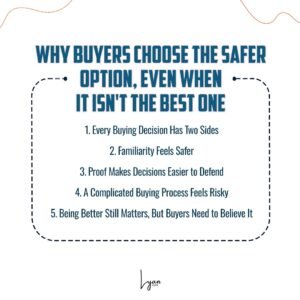
Every Buying Decision Has Two Sides
When we sell, we naturally focus on what the customer stands to gain.
More revenue. Lower costs. Better efficiency. Faster growth.
But buyers are looking at the other side too.
What if implementation fails? What if the team doesn’t use it? What if results don’t come? What if they’ve chosen the wrong company?
The larger the purchase, the louder these questions become.
This is why a great offer can still struggle to convert. The potential upside may be obvious, but if the perceived risk feels equally large, buyers hesitate.
Reducing that risk is often just as important as explaining the benefits.
Key Insight
A buyer isn’t only asking, “What could I gain?” They’re also asking, “What could go wrong?”
-
Familiarity Feels Safer
There’s a reason established brands have an advantage.
We’ve heard their names before.
We’ve seen other people use them.
We know roughly what to expect.
That familiarity reduces the feeling of risk.
Smaller or newer businesses often try to compete by saying they’re better, faster, or more innovative. But if the buyer doesn’t know them, those claims alone don’t create confidence.
This is where visibility becomes important.
When buyers repeatedly see your content, find you through search, read your case studies, or hear your name from other people, you gradually stop feeling like an unknown option.
You become familiar.
And familiarity makes decisions easier.
Key Insight
People are more comfortable buying from businesses they already recognize.
-
Proof Makes Decisions Easier to Defend
A case study does more than show that your service works.
It gives the buyer something they can use to justify their decision.
Imagine you’re recommending an agency to your management team.
Which statement feels stronger?
“I liked what they said during the meeting.”
Or:
“They’ve already solved this exact problem for three companies similar to ours.”
That’s why proof matters so much in B2B buying.
Testimonials, case studies, customer logos, results, certifications, and examples of previous work all reduce the amount of faith required from the buyer.
You’re no longer asking them to believe a promise.
You’re showing them evidence.
Key Insight
Good proof doesn’t just build trust. It helps buyers justify choosing you
-
A Complicated Buying Process Feels Risky
Sometimes businesses accidentally create uncertainty themselves.
The proposal is difficult to understand. Pricing has too many variables. Nobody clearly explains what happens after payment. The customer doesn’t know who will manage the project or when they’ll see the first result.
None of these things necessarily mean the company will deliver badly.
But from the buyer’s perspective, they create questions.
And unanswered questions feel like risk.
A clear process has the opposite effect. When customers understand what happens first, what happens next, and what they can expect along the way, the decision feels more manageable.
Key Insight
The easier your process is to understand, the safer your business feels to buy from.
-
Being Better Still Matters, But Buyers Need to Believe It
This is where businesses sometimes get frustrated.
They know their service is better.
They know their team is stronger.
They know they can deliver a better result than the competitor.
But the buyer doesn’t have access to everything you know.
They only have what you’ve shown them.
That’s why positioning, content, customer stories, websites, reviews, and communication matter. They translate your internal capability into something the market can actually see.
Being better is valuable.
Making that difference believable is what turns it into a competitive advantage.
Key Insight
Your advantage only matters when customers can see enough evidence to trust it.
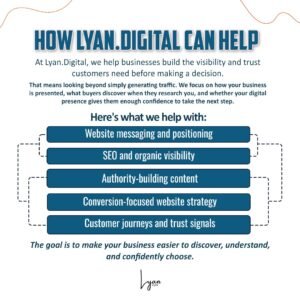
How Lyan.Digital Can Help
At Lyan.Digital, we help businesses build the visibility and trust customers need before making a decision.
That means looking beyond simply generating traffic. We focus on how your business is presented, what buyers discover when they research you, and whether your digital presence gives them enough confidence to take the next step.
Here’s what we help with:
- Website messaging and positioning
- SEO and organic visibility
- Authority-building content
- Conversion-focused website strategy
- Customer journeys and trust signals
The goal is to make your business easier to discover, understand, and confidently choose
Frequently Asked Questions
Why do customers choose competitors with weaker products? The competitor may feel more familiar, credible, or proven. Buyers can choose the option that feels less risky even when another solution appears technically stronger.
How can a smaller business compete with an established company? Build proof around your expertise. Strong case studies, useful content, clear positioning, customer testimonials, and consistent visibility can significantly reduce the trust gap.
What creates trust before a sales conversation? Your website, search presence, reviews, content, customer stories, and overall digital footprint all influence how customers perceive your business.
Can better branding improve sales? Branding alone won’t fix a weak offer, but a credible and consistent brand can make a strong offer easier for customers to trust.
Here’s how it helps
A New Software Company Competing with an Established Platform
The software offered stronger functionality, but prospects continued choosing the established competitor. Once the company began publishing detailed case studies and implementation stories, buyers had more evidence to support choosing the newer option.
A B2B Supplier Losing Deals Despite Competitive Pricing
Price wasn’t the real issue. Buyers were uncertain about delivery reliability. Making past project experience, supply capabilities, and customer proof more visible helped address the actual concern.
A Consulting Firm with Strong Expertise but Weak Online Presence
Most new prospects had never heard of the firm. Building a stronger website and publishing useful industry content meant prospects arrived at sales conversations already familiar with their expertise.
Customers don’t always choose the objectively best option.
They choose the option they feel comfortable saying yes to.
That difference matters.
You can have the stronger product, the better team, or the smarter solution and still lose if the buyer feels uncertain about choosing you.
So instead of only asking, “How do we prove we’re better?” there’s another question worth asking:
“How do we make choosing us feel less risky?”
The answer might be better proof, clearer communication, stronger visibility, or a simpler buying process.
Because when two good options are sitting in front of a buyer, the safest decision often wins.