There was a time when publishing regularly was almost a strategy by itself.
Write blogs, post on LinkedIn, send newsletters, stay active on social media, and eventually people would notice.
Today, almost every business is doing some version of that.
Companies are publishing three times a week. Founders are posting every day. AI has made it possible to produce twenty articles in the time it once took to write two.
So there is definitely more content.
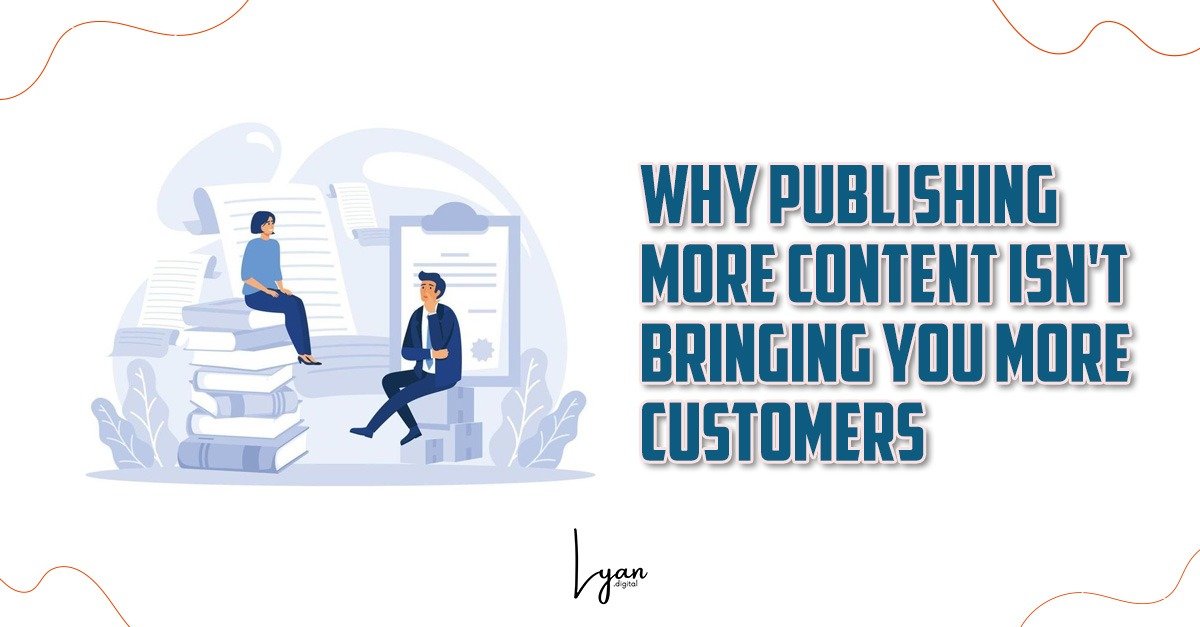
But that doesn’t necessarily mean there are more customers.
I’ve seen businesses with hundreds of published posts still struggle to generate meaningful enquiries. The problem isn’t always the quality either. Some of the content is genuinely useful.
The issue is that publishing content and building demand are two different things.
If your content attracts the wrong people, answers questions unrelated to your offer, or gives readers no reason to remember your business, increasing the volume won’t change much.
Before creating the next fifty pieces, it may be worth asking whether the content you already publish is actually helping customers move towards you.
1. You’re Writing for Traffic Instead of Buyers
A keyword can bring 10,000 visitors and still generate very little business.
This happens more often than people realize.
A company looks at search volume, finds popular topics in its industry, and starts publishing around them. Traffic increases, so the strategy appears to be working.
But who exactly is arriving?
If you’re selling enterprise software and most of your content attracts students looking for definitions, the traffic number doesn’t mean much commercially.
Good SEO isn’t simply about finding keywords with high search volume. It’s about understanding what your potential customers search for before they make a decision.
Sometimes 200 highly relevant visitors are worth far more than 20,000 random ones.
Key Insight
Traffic becomes valuable when the people arriving are actually capable of becoming customers.
2. Your Content Is Useful but Forgettable
This is becoming a much bigger problem.
Open almost any company blog and you’ll find articles like “10 Ways to Improve Productivity” or “5 Benefits of Digital Transformation.”
There’s nothing necessarily wrong with them.
They’re just difficult to remember.
The internet is already full of content that explains the obvious.
If your article says roughly the same thing as the other twenty results, readers may get their answer, close the tab, and forget which company gave it to them.
Useful content answers a question.
Strong content also gives the reader a perspective they associate with your business.
Key Insight
If your content sounds like everyone else’s, readers have no reason to remember who wrote it.
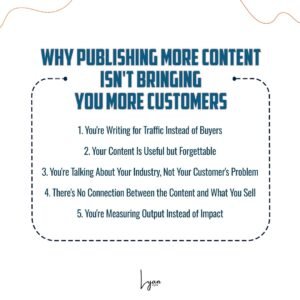
3. You’re Talking About Your Industry, Not Your Customer’s Problem
This distinction matters.
Businesses naturally create content around what they know.
An SEO agency talks about SEO.
A software company talks about software.
A cybersecurity company talks about cybersecurity.
But customers aren’t necessarily thinking in those categories.
They’re thinking about problems.
“Why has our website traffic dropped?”
“Why is our sales team wasting time updating spreadsheets?”
“Why are customers abandoning checkout?”
Those are very different starting points.
Content becomes more commercially useful when it begins with the situation the customer is experiencing and then connects that situation to your expertise.
Key Insight
Your customers aren’t searching for your expertise. They’re usually searching for an answer to their problem.
4. There’s No Connection Between the Content and What You Sell
This is one of the easiest mistakes to make.
A company publishes an excellent article.
People find it.
They read the whole thing.
Then they reach the end and leave.
The article did its job as content, but it didn’t do much for the business.
Not every blog needs a hard sales pitch. In fact, forcing one usually makes the article worse.
But there should be a natural connection between what someone just learned and what your business can help them do next.
That could be another relevant article, a service page, a case study, or a simple invitation to speak with the team.
Content should create a path, not a dead end.
Key Insight
Good content earns attention. A good content system knows where to take that attention next.
5. You’re Measuring Output Instead of Impact
“How many blogs did we publish this month?”
It’s an easy metric to track.
It also doesn’t tell you very much.
Ten articles that nobody relevant reads aren’t necessarily better than two articles that repeatedly bring qualified prospects to your website.
Instead, look further down the journey.
Which articles attract the right audience?
Which pages lead visitors towards your services?
What topics keep bringing traffic six months after publication?
Which content appears during real sales conversations?
Once you start looking at content this way, the goal changes from publishing more to publishing with a reason.
Key Insight
The number of articles you publish matters far less than what those articles actually do for the business.
How Lyan.Digital Can Help
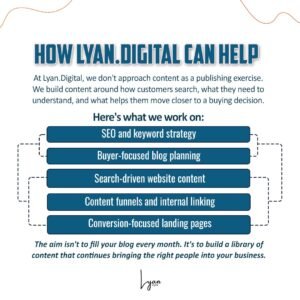
At Lyan.Digital, we don’t approach content as a publishing exercise. We build content around how customers search, what they need to understand, and what helps them move closer to a buying decision.
Here’s what we work on:
- SEO and keyword strategy
- Buyer-focused blog planning
- Search-driven website content
- Content funnels and internal linking
- Conversion-focused landing pages
The aim isn’t to fill your blog every month. It’s to build a library of content that continues bringing the right people into your business.
Frequently Asked Questions
How often should a business publish blog content? There isn’t a fixed number. Publishing consistently helps, but relevance and quality matter more than maintaining an arbitrary posting frequency.
Why is my blog getting traffic but no leads? Your articles may be attracting informational visitors who don’t match your target customer, or there may be no clear journey from the content towards your services.
Should every blog directly promote a service? No. Content should first answer the reader’s question properly. The connection to your service should appear naturally where it’s relevant.
Is AI-generated content bad for SEO?
Using AI itself isn’t the core issue. Publishing generic, inaccurate, repetitive, or low-value content is. Whatever tools are used, the final content still needs to be genuinely useful to the reader.
Real-Life Scenarios
A B2B Company With Thousands of Monthly Blog Visitors Traffic looked impressive, but enquiries from the blog were almost nonexistent. Most articles targeted broad educational keywords. Shifting towards topics connected to real buyer problems brought less overall traffic but better commercial enquiries.
A Software Company Publishing Every Week The team had maintained a consistent blog for more than a year, but most articles ended without directing readers anywhere useful. Connecting relevant articles to product pages, case studies, and demos gave existing content a clearer commercial role.
A Consulting Firm With Strong Expertise but Generic Content The firm’s consultants had years of experience, but their articles sounded similar to everything else ranking online. Bringing real observations, opinions, and client questions into the content made their expertise much easier to recognize.
Publishing more content can feel productive. There’s always another keyword to target, another article to write, and another post to schedule. But volume isn’t the difficult part anymore. Almost anyone can produce content at scale.
The harder question is whether your content gives the right person a reason to discover you, trust you, remember you, and eventually consider working with you. That’s a very different standard.
Before increasing your publishing schedule, look at the content you already have. See who it’s attracting, where those readers go next, and whether the topics connect to problems your business actually solves. You may not need more content.
You may need every piece of content to have a clearer job.