There’s something frustrating about watching a competitor grow when you know your business can deliver equally good, if not better, results.
You see them announcing new clients, expanding their team, and appearing regularly in search results. Meanwhile, your business has the experience, the right people, and a reliable service, but new enquiries aren’t coming in as consistently as you’d like.
The obvious assumption is that they’re spending more on marketing. Sometimes that’s true, but money isn’t always the reason.
Quite often, the difference comes down to how easily customers can discover and evaluate a business. Your competitor may be answering questions that your website hasn’t addressed, appearing for searches you’ve overlooked, or giving potential customers more reasons to contact them.
Customers don’t have access to an objective ranking of every company in your industry. They make decisions using the information they can find.
And that’s where some businesses gain an advantage long before a sales conversation begins.
1. Your Competitors Are Showing Up Earlier in the Buying Journey
Consider how someone searches for a service they haven’t purchased before. They rarely begin by contacting a company immediately. They research the problem, compare possible approaches, understand the costs involved, and gradually shortlist providers.
A business that appears throughout this research process has several opportunities to become familiar to the buyer.
This is where SEO and educational content become valuable. A competitor publishing useful articles around customer questions may reach potential buyers before those buyers are ready to enquire.
By the time the customer begins comparing service providers, that competitor is no longer a completely unfamiliar name.
Key Insight: Being discovered early gives your business more opportunities to build familiarity before customers start comparing providers.
2. Their Website Makes It Easier to Take the Next Step
Two businesses can attract similar website traffic and receive very different numbers of enquiries.
Sometimes the explanation is surprisingly simple. One website clearly explains its services, shows relevant examples, and makes contacting the business straightforward. The other requires visitors to navigate several pages before understanding what to do.
Customers aren’t usually willing to spend much time figuring this out. If they’re comparing multiple providers, an unnecessarily complicated website gives them another reason to leave.
It’s worth looking at your website from the perspective of someone who knows nothing about your company. Can they understand your services without speaking to anyone? Can they find evidence of your work? Is the enquiry process convenient?
These details influence whether an interested visitor becomes an actual lead.
Key Insight: A website that makes enquiries easier can outperform a more attractive website with a confusing customer journey.

3. They’re Building Trust Before Customers Contact Them
Imagine comparing two consulting firms. Both claim to have experienced teams and strong industry knowledge.
One website provides detailed case studies, customer testimonials, useful articles, and examples of completed projects. The other has a company profile, a list of services, and a contact form.
Which would you feel more comfortable contacting?
This doesn’t automatically mean the first company is better. It simply gives you more information to make a decision.
Businesses sometimes underestimate how much research happens before an enquiry. Customers may visit LinkedIn profiles, read Google reviews, explore blog articles, and look for evidence that the company understands their industry.
If your competitors make that evidence easier to find, they have an advantage that has very little to do with pricing.
Key Insight: Customers are more likely to consider businesses that give them enough evidence to evaluate their credibility.
4. Their Marketing Speaks to a More Specific Audience
A common mistake in business marketing is trying to appeal to everyone.
The website promises solutions for businesses of all sizes. The content covers dozens of unrelated subjects, and the advertisements speak about general benefits that could apply to almost any company.
The problem is that customers want to know whether you understand their particular situation.
A manufacturer looking for an ERP implementation partner has different concerns from a retail company searching for inventory software. Even when the underlying service is similar, the buying questions can be very different.
Competitors who understand these differences can create more relevant landing pages, content, and campaigns.
They may attract fewer people overall, but the people they attract are more likely to recognize the relevance of their offer.
Key Insight: Marketing becomes more effective when customers can immediately recognize that your business understands their specific needs.
5. They’re Learning From Their Marketing Instead of Just Running It
One advantage that growing businesses often have is a clearer understanding of what’s producing results.
They know which search terms generate enquiries, which landing pages perform well, and which campaigns attract customers who eventually purchase.
This allows them to make better decisions about where to invest.
Other businesses continue running campaigns without properly examining what happens afterwards. They know how much they spent and how many leads arrived, but they may not know which enquiries were qualified or which channels produced actual customers.
Without that information, it’s easy to keep investing in activities that look productive but contribute very little revenue.
Key Insight: Competitors who understand their marketing performance can improve faster than businesses relying mainly on assumptions.
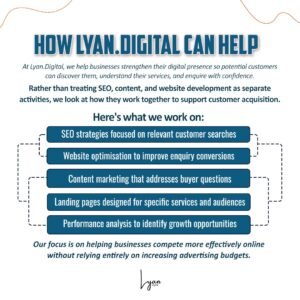
How Lyan.Digital Can Help
At Lyan.Digital, we help businesses strengthen their digital presence so potential customers can discover them, understand their services, and enquire with confidence.
Rather than treating SEO, content, and website development as separate activities, we look at how they work together to support customer acquisition.
Here’s how we help:
- SEO strategies focused on relevant customer searches
- Website optimisation to improve enquiry conversions
- Content marketing that addresses buyer questions
- Landing pages designed for specific services and audiences
- Performance analysis to identify growth opportunities
Our focus is on helping businesses compete more effectively online without relying entirely on increasing advertising budgets.
Frequently Asked Questions
Why are my competitors getting more leads than my business? They may have stronger search visibility, clearer website messaging, more effective campaigns, or better conversion processes. Comparing traffic alone won’t reveal the complete picture.
How can I find out what my competitors are doing online? Review their websites, search rankings, content, advertisements, and customer reviews. SEO and competitor research tools can also help identify keywords and content opportunities.
Can SEO help me compete with larger businesses? Yes. Targeting relevant, specific search queries can help smaller businesses attract customers, even when larger competitors dominate broader keywords.
Should I increase my advertising budget to compete? Not necessarily. First examine whether your existing traffic is relevant and whether your website converts visitors effectively. Increasing spending before addressing these issues may waste money.
Here’s how it helps
A Manufacturing Supplier Losing Enquiries to Newer Competitors
An established supplier has decades of experience but receives few enquiries through its website. Newer competitors have detailed product pages, application-specific content, and stronger search visibility. Improving the supplier’s website structure and product information could help it compete for buyers already searching online.
A Consulting Firm Struggling Against Larger Agencies
A smaller consulting firm finds that larger agencies dominate broad industry searches. Instead of competing for every keyword, it focuses on specific services and customer problems where its expertise is particularly relevant.
A B2B Technology Company With Inconsistent Lead Generation
The company runs advertising campaigns but struggles to understand which enquiries are worth pursuing. Connecting campaign data with lead quality and sales outcomes helps the team identify which marketing activities deserve further investment.
It’s tempting to assume that competitors are growing because they have bigger budgets, better connections, or more aggressive sales teams. Sometimes they do. But there are also businesses winning opportunities simply because they’ve made themselves easier to find, easier to understand, and easier to contact.
That should make every business owner think carefully about their own digital presence. If a potential customer searched for your services today, would they find you? And if they did, would your website give them enough confidence to enquire?
These are worth answering before deciding that your business needs another advertising campaign. Your competitors may not be delivering a better service. They may simply be doing a better job of helping customers discover the service they deliver.