Most B2B messaging starts with features.
Dashboards.
Integrations.
Automation.
Analytics.
And while features matter they don’t close enterprise deals.
Enterprise buyers don’t buy tools.
They buy outcomes.
They buy:
- Revenue predictability
- Risk reduction
- Operational leverage
- Competitive advantage
If your messaging is feature-led, you’re inviting comparison.
If it’s outcome-led, you’re creating value.
This blog breaks down why feature-led messaging quietly limits deal size and how to rewrite it into outcome-led positioning that accelerates revenue.
-
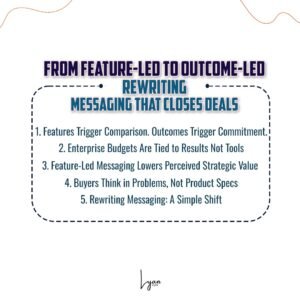
Features Trigger Comparison. Outcomes Trigger Commitment.
When you lead with features, buyers immediately start comparing.
“Do others offer this?”
“Is theirs better?”
“Can we get it cheaper?”
Feature-first messaging pushes you into competitive grids.
Outcome-led messaging shifts the question.
Instead of:
“What does this tool do?”
The buyer thinks:
“What will this change for us?”
That shift moves the conversation from technical evaluation to business impact.
Key Insights:
- Features invite comparison; outcomes invite investment.
- Enterprise decisions are justified by impact, not capability.
- Outcome framing increases perceived value.
-
Enterprise Budgets Are Tied to Results Not Tools
In large organizations, budgets are allocated around:
Growth initiatives
Efficiency improvements
Risk mitigation
Strategic transformation
No one gets budget approval because “this dashboard looks powerful.”
They get approval because:
“This will reduce churn by 12%.”
“This will cut operational waste.”
“This will shorten our sales cycle.”
If your messaging doesn’t connect directly to business metrics, it stays tactical.
Key Insights:
- Budget language is outcome language.
- ROI clarity accelerates approvals.
- Tools support results they are not the result.
-
Feature-Led Messaging Lowers Perceived Strategic Value
When you emphasize features, you position yourself as a utility.
Utilities are:
- Negotiated aggressively
- Compared relentlessly
- Replaced easily
Outcome-led messaging elevates you into a strategic category.
Strategic vendors:
- Command stronger margins
- Face fewer price objections
- Experience longer retention
Positioning determines pricing power.
Key Insights:
- Tactical messaging reduces pricing leverage.
- Strategic framing increases margin tolerance.
- Perception influences negotiation dynamics.
-
Buyers Think in Problems, Not Product Specs
Inside an enterprise, conversations sound like this:
“We need to improve pipeline velocity.”
“Our reporting is fragmented.”
“Sales and marketing aren’t aligned.”
No one says:
“We need advanced automation workflows.”
If your messaging doesn’t mirror how buyers speak internally, it feels disconnected.
Outcome-led messaging reflects the language used in internal meetings.
That alignment builds trust immediately.
Key Insights:
- Match internal buyer language.
- Speak to executive priorities, not product architecture.
- Resonance increases conversion speed.
-
Rewriting Messaging: A Simple Shift
Feature-led:
“We provide automated reporting dashboards with advanced filtering capabilities.”
Outcome-led:
“We give revenue leaders real-time visibility to eliminate blind spots and make faster decisions.”
Same product.
Completely different perception.
The first describes.
The second transforms.
Key Insights:
- Rewrite features as business impact.
- Focus on change, not capability.
- Transformation messaging converts better than explanation.
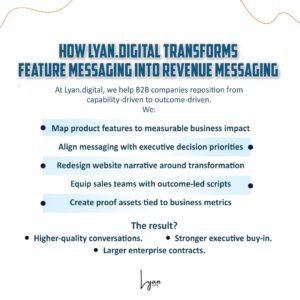
How Lyan.digital Transforms Feature Messaging into Revenue Messaging
At Lyan.digital, we help B2B companies reposition from capability-driven to outcome-driven.
We:
- Map product features to measurable business impact
- Align messaging with executive decision priorities
- Redesign website narrative around transformation
- Equip sales teams with outcome-led scripts
- Create proof assets tied to business metrics
The result?
Higher-quality conversations.
Stronger executive buy-in.
Larger enterprise contracts.
Frequently Asked Questions
Are features still important? Yes but they support outcomes. They shouldn’t lead the narrative.
Will outcome-led messaging work for technical buyers? Yes. Even technical buyers justify decisions through business impact.
Does this change require product adjustments? Usually not. It’s a positioning shift, not a product rebuild.
Can outcome-led messaging reduce sales cycle length? Yes. Clear impact accelerates internal approval.
What’s the biggest mistake companies make? Confusing product sophistication with strategic relevance.
Should marketing and sales align on this shift? Absolutely. Narrative consistency is critical.
Does this improve pricing power? Yes. Strategic value reduces price sensitivity.
Here’s How This Helps
- A SaaS company shifted from automation features to pipeline acceleration outcomes. Enterprise buyers began involving revenue leaders earlier in the process.
- A cybersecurity vendor reframed messaging from “advanced protection layers” to “reduced regulatory risk.” Procurement approvals moved faster.
- A B2B analytics firm stopped listing dashboards and started positioning executive decision clarity. Close rates increased within one quarter.
- An operations platform replaced feature-heavy landing pages with business impact storytelling. Demo-to-deal conversion improved significantly.
Features explain what you built. Outcomes explain why it matters. Enterprise buyers don’t purchase functionality. They invest in change.
When your messaging shifts from what your product does to what it delivers,
you stop competing on comparison and start competing on impact.