B2B purchases rarely fail because of product gaps. They fail because of internal politics.
Enterprise buying is not a straight line from interest to approval. It is a web of incentives, risk calculations, departmental priorities, and personal reputations. Every stakeholder has something to gain and something to protect.
If you ignore internal dynamics, even the strongest solution can lose. But when you understand how buying committees actually operate, you stop selling to one person and start influencing the room.
This is where most deals are quietly won or lost.
-
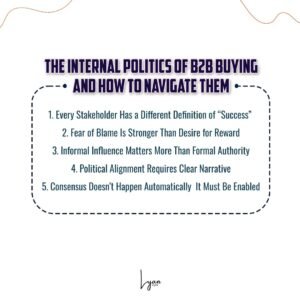
Every Stakeholder Has a Different Definition of “Success”
Your champion might care about efficiency.
Finance cares about cost control.
IT cares about integration risk.
Legal cares about compliance.
Executives care about strategic impact.
If your messaging only satisfies one perspective, resistance emerges elsewhere.
Enterprise buying isn’t about convincing one person. It’s about aligning multiple definitions of value.
Key Insights:
- Stakeholders evaluate from different risk lenses.
- Misaligned messaging increases friction.
- Multi-angle value positioning accelerates consensus.
-
Fear of Blame Is Stronger Than Desire for Reward
In enterprise environments, people are rarely rewarded for bold decisions but they are punished for bad ones.
That’s why buyers lean toward “safe” vendors.
Even if your solution is stronger, if it feels riskier or newer, internal hesitation grows.
Your job is not just to show upside. It’s to eliminate perceived career risk.
Key Insights:
- Risk avoidance drives enterprise behaviour.
- Safety often outweighs innovation.
- Perceived stability increases deal probability.
-
Informal Influence Matters More Than Formal Authority
The person with the budget isn’t always the person shaping opinion.
Informal influencers respected managers, senior specialists, long-tenured employees can sway internal direction.
If they feel unconvinced or excluded, momentum slows quietly.
Understanding influence networks inside an organization helps you support your champion strategically.
Key Insights:
- Influence doesn’t always follow hierarchy.
- Internal advocates need reinforcement.
- Silent resistance can stall deals.
-
Political Alignment Requires Clear Narrative
When internal conversations begin, your positioning must be easy to repeat.
If your value proposition is complex, abstract, or inconsistent, stakeholders interpret it differently and misalignment spreads.
Clear narrative simplifies internal alignment.
The easier your story is to retell, the easier it is to approve.
Key Insights:
- Memorability supports internal advocacy.
- Narrative clarity reduces distortion.
- Simplicity accelerates agreement.
-
Consensus Doesn’t Happen Automatically It Must Be Enabled
Most vendors assume internal consensus is the buyer’s responsibility.
But strategic vendors actively support it.
This can include:
- Executive summaries
- Risk mitigation briefs
- ROI projections
- Industry-specific case studies
When you provide tools that make internal discussions easier, decisions move faster.
Key Insights:
- Decision enablement shortens sales cycles.
- Structured materials reduce uncertainty.
- Support strengthens internal champions.
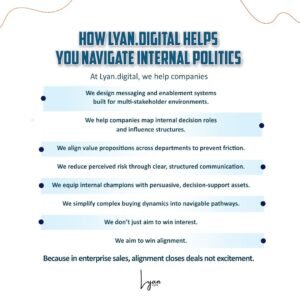
How Lyan.digital Helps You Navigate Internal Politics
At Lyan.digital, we design messaging and enablement systems built for multi-stakeholder environments. We help companies map internal decision roles, align value propositions across departments, reduce perceived risk, and equip champions with persuasive assets.
The goal isn’t just to win interest it’s to win alignment.
Frequently Asked Questions
Can we influence internal politics from outside the organization? Yes. Through structured messaging and enablement tools.
Should messaging differ for each stakeholder? Yes. Value framing must match departmental priorities.
How do we reduce fear of blame? By emphasizing proof, precedent, and risk mitigation.
Does internal politics lengthen sales cycles? Often, yes unless proactively managed.
Should we push for executive involvement early? When appropriate, executive buy-in reduces downstream friction.
Can strong branding reduce political resistance? Authority and recognition increase trust.
What’s the biggest mistake vendors make? Assuming enthusiasm equals alignment.
Real-Life Scenarios
- A SaaS platform struggled with deals stalling at procurement. By creating department-specific value briefs, consensus formed more efficiently.
- A cybersecurity vendor reframed its messaging around compliance assurance, easing legal concerns and accelerating approval.
- A B2B automation firm equipped its internal champion with ROI slides tailored for finance leaders. Budget approval moved forward within weeks.
- An analytics company identified an informal technical influencer blocking progress and addressed their concerns directly with integration documentation.
Enterprise buying is not just logical it’s political.
Understanding incentives, fears, and internal alignment dynamics transforms how you sell.
When you support consensus instead of assuming it,
deals don’t just move they close.