Revenue forecasting is often treated as a mathematical exercise. Probability percentages, deal stages, weighted pipelines everything looks structured inside the CRM. But when the quarter closes and results fluctuate, leaders are left wondering why forecasts felt so confident yet turned out so uncertain.
The issue isn’t the math. It’s the assumptions behind it.
Most forecasting models rely on internal pipeline stages while ignoring how buyers actually behave. They track where deals sit not how seriously buyers are moving. And that gap between stage progression and behavioral intent is where predictability quietly breaks down.
-
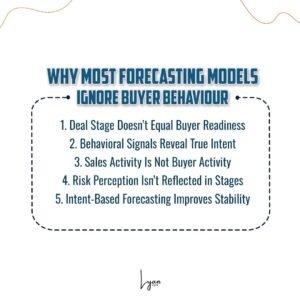
Deal Stage Doesn’t Equal Buyer Readiness
A deal marked as “Proposal Sent” doesn’t mean the buyer is close to signing. It only means you’ve completed your step.
What matters more is:
- Who has reviewed the proposal
- Whether executive stakeholders are involved
- How quickly responses arrive
- Whether internal alignment is visible
Forecasts that ignore buyer-side activity create blind spots.
Key Insights:
- Internal stages don’t reflect buyer momentum.
- Behaviour signals seriousness.
- Readiness predicts revenue better than labels.
-
Behavioral Signals Reveal True Intent
High-intent buyers behave differently.
They:
- Revisit pricing pages
- Engage with ROI materials
- Ask implementation-specific questions
- Loop in decision-makers
These behaviors signal progress more accurately than CRM updates.
If your forecasting model doesn’t incorporate behavioral data, it relies on optimism rather than evidence.
Key Insights:
- Engagement depth predicts closure probability.
- Intent data improves forecasting precision.
- Buyer actions matter more than internal optimism.
-
Sales Activity Is Not Buyer Activity
A rep sending follow-ups and booking calls creates motion. But buyer-side silence can indicate hesitation.
Forecasting models often overvalue seller activity and undervalue buyer engagement.
Revenue predictability improves when buyer responsiveness becomes part of qualification criteria.
Key Insights:
- Seller effort doesn’t equal buyer commitment.
- Responsiveness signals momentum.
- Engagement asymmetry increases risk.
-
Risk Perception Isn’t Reflected in Stages
Deals may remain in the same stage while internal risk perception increases.
Budget shifts, leadership changes, or compliance concerns may not be visible inside the CRM but they affect close probability dramatically.
Forecast models that don’t factor risk signals create inflated confidence.
Key Insights:
- Risk dynamics affect deal progression.
- External context influences closure probability.
- Monitoring uncertainty improves projections.
-
Intent-Based Forecasting Improves Stability
Instead of assigning fixed probabilities per stage, progressive companies are incorporating intent signals into forecasting:
- Stakeholder involvement
- Decision-timeline clarity
- Behavioral engagement
- Risk mitigation progress
This creates a more realistic pipeline assessment.
Key Insights:
- Intent scoring increases predictability.
- Behavioral weighting reduces variance.
- Context-aware forecasting improves leadership confidence.
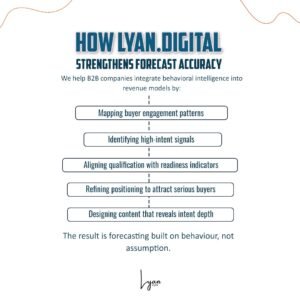
How Lyan.digital Strengthens Forecast Accuracy
We help B2B companies integrate behavioral intelligence into revenue models by:
- Mapping buyer engagement patterns
- Identifying high-intent signals
- Aligning qualification with readiness indicators
- Refining positioning to attract serious buyers
- Designing content that reveals intent depth
The result is forecasting built on behaviour, not assumption.
Frequently Asked Questions
Should we abandon stage-based forecasting? No. But it should be supplemented with behavioral indicators.
What are the strongest intent signals? Stakeholder involvement, repeated engagement, and timeline clarity.
Can small teams implement behavioral forecasting? Yes. Even basic engagement tracking improves accuracy.
Does this reduce revenue volatility? Yes. Intent-based forecasting improves predictability.
How quickly can forecasting improve? With proper tracking, noticeable improvements can happen within one quarter.
Does positioning impact forecast accuracy? Yes. Clear positioning attracts more serious buyers.
What’s the biggest forecasting mistake? Treating all deals in the same stage as equally likely to close.
Real-Life Scenarios
A SaaS company began incorporating stakeholder engagement levels into forecasting. Revenue predictions became significantly more accurate.
A cybersecurity vendor tracked buyer-side content consumption patterns. Forecast adjustments improved close alignment.
A B2B automation firm added responsiveness scoring to pipeline analysis. Deal slippage became easier to anticipate.
An analytics platform refined qualification criteria to include timeline clarity. Quarterly volatility reduced.
If your forecasts feel confident but unpredictable, it may be time to rethink what you’re measuring. Stages show process behaviour shows intent. When you align forecasting with how buyers actually move, revenue becomes less reactive and more reliable. Precision doesn’t come from more data it comes from the right data.