
Many companies think revenue problems are performance problems. They tweak ad budgets, hire more sales reps, add automation tools, or push for more outbound. But growth stalls not because effort is low it stalls because alignment is broken.
Marketing speaks in awareness. Sales speaks in objections. Leadership speaks in revenue targets. Narrative gets fragmented somewhere in between.
Revenue architecture isn’t about tactics. It’s about structural alignment. When positioning, messaging, qualification, and sales progression operate from the same strategic foundation, growth becomes steadier, clearer, and more predictable.
-
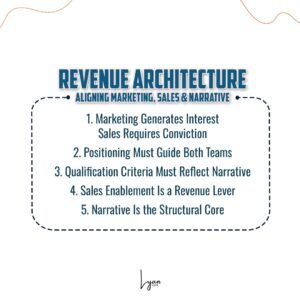
Marketing Generates Interest Sales Requires Conviction
Marketing often focuses on traffic and engagement. Sales focuses on closing.
If the narrative that attracts attention isn’t the same narrative that supports conversion, friction appears mid-funnel.
Buyers feel the disconnect immediately.
Key Insights:
- Inconsistent narratives reduce trust.
- Alignment strengthens progression.
- Messaging continuity improves conversion.
-
Positioning Must Guide Both Teams
If marketing positions you as strategic but sales conversations drift into tactical detail, deal perception shrinks.
If sales reframe value differently from website messaging, credibility weakens.
Positioning should not change between departments.
It should anchor them.
Key Insights:
- Shared positioning increases authority.
- Consistency builds confidence.
- Strategic framing influences deal size.
-
Qualification Criteria Must Reflect Narrative
If your messaging attracts enterprise buyers but your qualification process prioritizes speed over depth, misalignment follows.
Revenue architecture ensures:
- Marketing attracts the right profile
- Sales qualifies against the same intent signals
- Forecasting reflects readiness, not optimism
Structure reduces unpredictability.
Key Insights:
- Intent alignment improves forecast accuracy.
- Clear criteria prevent pipeline inflation.
- Shared metrics strengthen trust.
-
Sales Enablement Is a Revenue Lever
Revenue stalls when sales lacks:
- Clear positioning language
- Decision-enablement tools
- ROI summaries
- Risk-reduction narratives
Enablement isn’t support. It’s acceleration.
When sales can articulate value clearly and consistently, deals move faster.
Key Insights:
- Clear language improves persuasion.
- Decision support reduces internal friction.
- Enablement strengthens momentum.
-
Narrative Is the Structural Core
Tools can be replaced. Tactics can evolve.
But narrative how your company defines the problem and positions the solution — becomes the foundation for sustainable growth.
When narrative aligns across marketing and sales, every touchpoint reinforces momentum instead of resetting it.
Key Insights:
- Narrative continuity drives trust.
- Alignment reduces leakage.
- Structural clarity increases stability.
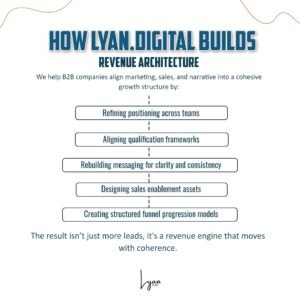
How Lyan.digital Builds Revenue Architecture
We help B2B companies align marketing, sales, and narrative into a cohesive growth structure by:
- Refining positioning across teams
- Aligning qualification frameworks
- Rebuilding messaging for clarity and consistency
- Designing sales enablement assets
- Creating structured funnel progression models
The result isn’t just more leads it’s a revenue engine that moves with coherence.
Frequently Asked Questions
Is revenue architecture different from funnel optimization? Yes. It focuses on alignment, not just conversion tweaks.
Can small teams benefit from this? Absolutely. Alignment matters at every scale.
How do we identify narrative misalignment? Review messaging differences between marketing materials and sales calls.
Does alignment shorten sales cycles? Yes. Consistency reduces hesitation.
Can narrative changes increase deal size? Often, yes. Strategic framing elevates perceived value.
How long does alignment take? Initial improvements can happen within weeks.
Is this only for enterprise companies? No, but enterprise deals benefit most.
Here’s how it helps
- A SaaS company aligned marketing and sales messaging around executive-level outcomes. Deal sizes increased as positioning strengthened.
- A cybersecurity vendor standardized qualification criteria across departments. Forecast reliability improved significantly.
- A B2B automation firm rebuilt its website narrative to match sales conversations. Mid-funnel drop-off decreased.
- An analytics platform created unified positioning documents for both marketing and sales teams. Internal clarity improved revenue consistency.
If your revenue feels inconsistent despite strong activity, the issue may not be effort it may be alignment. When marketing, sales, and narrative operate from the same strategic core, growth becomes smoother and more predictable. Instead of adding more tactics, strengthen your structure. Coherence compounds faster than volume.