Most teams assume that once a demo goes well, the hardest part is over. The prospect understands the product, asks the right questions, and even expresses enthusiasm. Yet weeks later, the deal slows down, follow-ups stretch, and eventually momentum fades. This isn’t a demo problem. It’s a mid-funnel problem. The space between interest and internal approval is where most B2B deals quietly collapse. And the reason isn’t product weakness it’s narrative, alignment, and decision friction.
-
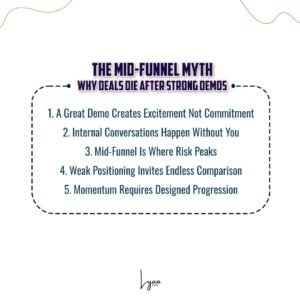
A Great Demo Creates Excitement Not Commitment
Demos generate interest. But enterprise buying requires justification.
After the demo, buyers must:
- Explain value internally
- Compare alternatives
- Assess risk
- Evaluate implementation
Excitement doesn’t survive internal scrutiny without structure.
Key Insights:
- Interest is not intent.
- Post-demo clarity determines progression.
- Justification matters more than features.
-
Internal Conversations Happen Without You
Once the demo ends, discussions shift to rooms you’re not in.
Questions emerge:
- Is this necessary now?
- Is this safe?
- Can we defend this investment?
- What’s the real ROI?
If your messaging doesn’t provide language for these conversations, momentum weakens.
Key Insights:
- Deals move internally, not externally.
- Champions need defensible arguments.
- Silence often signals internal friction.
-
Mid-Funnel Is Where Risk Peaks
At the awareness stage, everything feels exploratory.
At the negotiation stage, alignment is clearer.
But mid-funnel is where:
- Implementation fears surface
- Budget scrutiny intensifies
- Stakeholder resistance appears
If risk isn’t addressed explicitly, delays follow.
Key Insights:
- Risk perception increases mid-funnel.
- Structured reassurance accelerates decisions.
- Clarity reduces hesitation.
-
Weak Positioning Invites Endless Comparison
If your narrative isn’t distinct, buyers revert to side-by-side comparison.
And comparison prolongs evaluation.
Mid-funnel success depends on shaping criteria not reacting to them.
Key Insights:
- Framing influences evaluation speed.
- Differentiation reduces indecision.
- Strong positioning limits price-based debates.
-
Momentum Requires Designed Progression
Most teams rely on follow-ups instead of forward structure.
High-performing teams:
- Set defined next steps
- Provide recap insights
- Share ROI briefs
- Offer decision-support materials
Mid-funnel isn’t passive. It must be engineered.
Key Insights:
- Structure prevents drift.
- Progression reduces ambiguity.
- Intent must be reinforced.
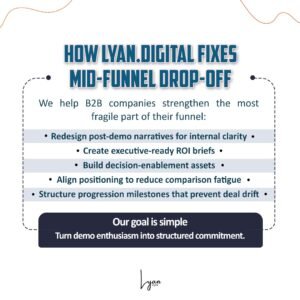
How Lyan.digital Fixes Mid-Funnel Drop-Off
We help B2B companies strengthen the most fragile part of their funnel:
- Redesign post-demo narratives for internal clarity
- Create executive-ready ROI briefs
- Build decision-enablement assets
- Align positioning to reduce comparison fatigue
- Structure progression milestones that prevent deal drift
Our goal is simple: turn demo enthusiasm into structured commitment.
Frequently Asked Questions
Why do deals stall after strong demos? Because internal alignment hasn’t been fully supported.
Should we increase follow-ups? Strategic follow-ups work. Repetitive reminders don’t.
Does pricing cause mid-funnel drop-off? Often, risk perception is the bigger factor.
Can content help mid-funnel progression? Yes. Decision support materials accelerate internal approval.
How do we identify mid-funnel friction? Analyze stage stagnation and objection patterns.
Can better positioning shorten mid-funnel time? Absolutely. Clear differentiation reduces delay.
Is mid-funnel optimization more important than lead generation? In many cases, yes.
Here’s how it helps
- A SaaS company added structured executive summaries after demos. Internal approvals accelerated within weeks.
- A cybersecurity vendor introduced compliance reassurance briefs. Procurement hesitation reduced significantly.
- A B2B automation firm replaced generic follow-ups with tailored ROI breakdowns. Close rates improved.
- An analytics provider implemented defined next-step frameworks. Stage stagnation decreased across enterprise deals.
If your deals feel strong at the demo stage but unpredictable afterward, the problem isn’t interest it’s structure. Mid-funnel success requires clarity, differentiation, and decision support that carries momentum forward. Instead of chasing more leads, focus on strengthening the stage where revenue quietly slips away. When progression is engineered intentionally, your pipeline becomes more stable, predictable, and easier to close.