There’s a pattern I’ve seen with businesses running digital marketing.
Website enquiries slow down, so the first response is to increase traffic.
Spend more on Google Ads. Publish more content. Improve SEO. Run another campaign. Get more people onto the website and surely more customers will come out the other end.
It sounds logical.
But there’s one problem.
If 1,000 people visit your website and almost nobody enquires, sending another 1,000 people to the same website doesn’t solve the real issue.
It simply gives more people the opportunity to leave.
Sometimes the problem isn’t traffic at all. The business may already be attracting the right audience, but something between the first visit and the final enquiry isn’t working.
Maybe the offer isn’t clear. Maybe customers can’t see enough proof. Maybe the website gives them information but never gives them a strong reason to act.
Before spending more money bringing people in, it’s worth understanding what happens once they arrive
-
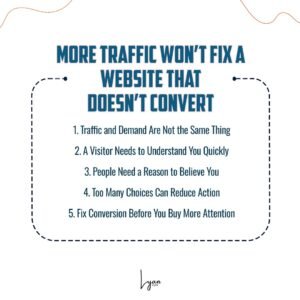
Traffic and Demand Are Not the Same Thing
Seeing website traffic increase feels good.
There’s movement. Analytics are going up. More people are discovering the brand.
But traffic alone tells you very little about whether the business is actually growing.
A website can receive thousands of visits and generate almost no meaningful enquiries. Another website can receive a fraction of that traffic and consistently produce customers.
The difference is often intent.
Getting more people to your website matters only when you’re attracting people who actually have a reason to care about what you sell.
This is why chasing traffic numbers alone can become misleading.
Key Insight
The goal isn’t more visitors. It’s more of the right visitors taking the right action
-
A Visitor Needs to Understand You Quickly
Imagine landing on a website for the first time.
You know nothing about the company.
You don’t know their history, their team, their process, or why they believe they’re different.
All you have is what appears in front of you.
If the homepage begins with a vague headline such as “Transforming Businesses Through Innovative Solutions,” what exactly does that tell you?
Not much.
Yet messaging like this appears everywhere.
A visitor shouldn’t need to open five pages to understand what you do, who you help, and why they should continue reading.
The quicker those answers become clear, the better chance you have of keeping their attention.
Key Insight
Visitors shouldn’t have to investigate your business before they understand it.
-
People Need a Reason to Believe You
You can say you provide excellent service.
So can every competitor.
You can say you have an experienced team, deliver quality work, and put customers first.
Again, almost everyone says the same thing.
At some point, buyers start looking for evidence.
Who have you worked with?
What have you delivered?
What results have customers achieved?
Are there case studies, reviews, testimonials, or examples of your work?
A website without proof asks visitors to take your claims at face value. A website with strong proof gives them something more concrete to evaluate.
That distinction becomes especially important when the purchase involves significant money or risk.
Key Insight
Claims create interest. Proof creates confidence.
-
Too Many Choices Can Reduce Action
There’s another problem that appears surprisingly often.
The website is trying to do everything.
There are seven services in the navigation, five calls-to-action on the homepage, several offers, multiple forms, and links going in every direction.
The business thinks it’s giving customers more choice.
The customer may simply feel unsure about what to do next.
Good websites guide visitors.
If someone arrives looking for a particular solution, the path from interest to enquiry should feel natural.
Every page doesn’t need ten different actions.
Sometimes one obvious next step works better.
Key Insight
A website should guide a decision, not hand the visitor a menu of decisions to make
-
Fix Conversion Before You Buy More Attention
This is where the economics become important.
Imagine you’re spending ₹1 lakh every month generating traffic.
If your website converts poorly, a large portion of that budget is being spent bringing people into an experience that doesn’t persuade them to act.
Increasing the advertising budget may increase enquiries, but the underlying inefficiency remains.
Improve the website first and the same marketing budget can suddenly work much harder.
That may mean changing the messaging, simplifying the customer journey, adding better proof, improving landing pages, or making the enquiry process easier.
Traffic becomes more valuable when the destination is doing its job.
Key Insight
Before paying for more visitors, make sure your website deserves the visitors you already have.
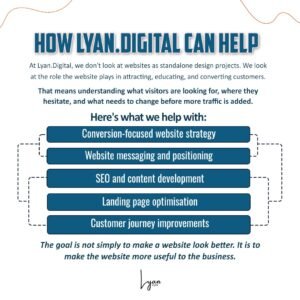
How Lyan.Digital Can Help
At Lyan.Digital, we don’t look at websites as standalone design projects. We look at the role the website plays in attracting, educating, and converting customers.
That means understanding what visitors are looking for, where they hesitate, and what needs to change before more traffic is added.
Here’s how we help:
- Conversion-focused website strategy
- Website messaging and positioning
- SEO and content development
- Landing page optimisation
- Customer journey improvements
The goal is not simply to make a website look better. It is to make the website more useful to the business
Frequently Asked Questions
What is a good website conversion rate? There isn’t one number that applies to every business. Conversion rates vary significantly depending on industry, traffic source, offer, price, and the action being measured.
Why am I getting traffic but no enquiries? The issue could be poor-quality traffic, unclear messaging, weak trust signals, an unattractive offer, or friction in the enquiry process.
Should I stop running ads if my website isn’t converting? Not necessarily. But before increasing your budget, it makes sense to understand why existing visitors aren’t converting and fix the biggest gaps.
Can redesigning a website improve conversions? It can, but design alone isn’t enough. Messaging, positioning, proof, user experience, and the offer itself all influence conversion.
Here’s how it helps
A B2B Company Spending More on Google Ads
The company kept increasing its ad budget because enquiries were below target. The traffic wasn’t the main issue. Prospects were landing on a generic services page with very little information relevant to the search that brought them there. Building focused landing pages gave those visitors a much clearer path to enquiry.
A Consulting Firm with Good Organic Traffic
Years of publishing content had created steady search traffic, but very few readers moved towards the firm’s services. Connecting informational content to relevant service pages and clearer calls-to-action helped turn existing traffic into commercial opportunities.
A Service Business Planning a Complete Website Redesign
The owner assumed the visual design was causing poor conversions. A closer look showed that customers couldn’t easily understand the difference between the company’s packages. Clarifying the offer became more important than rebuilding the entire site.
Getting more traffic is easy to understand.
You can see the number increase on a dashboard, which makes it feel like progress.
Conversion problems are less obvious.
They sit inside the words on your homepage, the questions customers still have, the proof you haven’t shown, and the steps you’re asking visitors to take.
That’s why increasing traffic shouldn’t always be the first answer when enquiries are low.
Look at what happens after people arrive.
If visitors are already showing up but very few are taking the next step, you may not need more attention yet.
You may simply need to do a better job with the attention you already have.