Most businesses are surprisingly good at measuring what happened.
They know how many enquiries came in, how many sales were closed, and how much revenue was generated. But there’s a much larger group of people that rarely shows up in those reports.
The visitor who spent five minutes on the website and left.
The prospect who almost filled out the enquiry form.
The buyer who was interested but never took the next step.
These people don’t usually explain why they left. They don’t send feedback. They don’t tell you what was missing. They simply disappear.
The challenge is that every silent exit represents a missed opportunity to learn. Understanding why customers leave without telling you why can reveal hidden friction, improve conversions, and help businesses grow without spending more on marketing.
Let’s explore some of the most common reasons customers walk away.
1. Interest Doesn’t Always Lead to Action
Many businesses assume that if someone didn’t buy, they probably weren’t serious in the first place.
That’s not always true.
Many prospects leave after showing genuine interest. They browse services, read reviews, compare options, and spend time understanding the business.
The issue is often not interest. It’s uncertainty.
If customers aren’t fully confident in the decision they’re about to make, they delay. And when decisions get delayed, they often never happen.
Key Insight
Many customers leave because they’re uncertain, not because they’re uninterested.
2. Small Questions Create Big Barriers
Customers rarely need every question answered before making a decision. But they do need enough confidence to move forward.
Sometimes the missing piece is pricing clarity.
Sometimes it’s understanding the process.
Sometimes it’s simply knowing what happens next.
These questions may seem small, but unanswered questions create friction. And friction slows decisions.
The problem is that most customers won’t ask. They’ll simply continue searching elsewhere.
Key Insight
A few unanswered questions can be enough to stop an otherwise interested buyer.
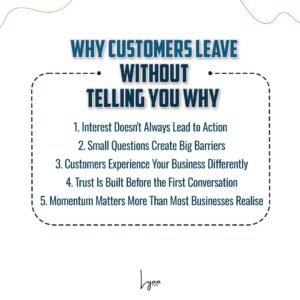
3. Customers Experience Your Business Differently
Inside the business, everything makes sense.
The team understands the services. The founder understands the value. The process feels straightforward.
Customers don’t have that context.
They only see what’s presented to them. A website that seems clear internally may feel confusing externally. An enquiry process that feels simple to the team may feel complicated to a first-time visitor.
This gap between internal understanding and customer experience often causes silent drop-offs.
Key Insight
Businesses see their processes from the inside. Customers experience them from the outside.
4. Trust Is Built Before the First Conversation
Most buying decisions begin long before a sales call.
Customers evaluate websites, testimonials, reviews, social proof, and content before deciding whether a business is worth contacting.
If those trust signals are weak, outdated, or missing, uncertainty grows.
Even if the service itself is excellent, customers may hesitate if they don’t feel confident in the business behind it.
Trust isn’t built when customers contact you.
Trust is often built before they decide to.
Key Insight
Customers often decide whether they trust your business before they ever speak to you.
5. Momentum Matters More Than Most Businesses Realise
Customer intent has a shelf life.
When someone is actively searching for a solution, there’s a window where interest is high and decisions are more likely.
Delays, confusion, or slow responses can quickly reduce that momentum.
The longer customers wait for clarity, the more likely they are to get distracted, postpone the decision, or move on entirely.
Businesses that make it easy to take the next step often convert more opportunities simply because they maintain momentum.
Key Insight
Interest fades over time. Momentum helps turn attention into action.
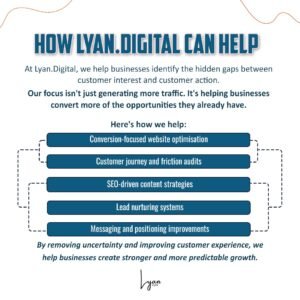
How Lyan.Digital Can Help
At Lyan.Digital, we help businesses identify the hidden gaps between customer interest and customer action.
Our focus isn’t just generating more traffic. It’s helping businesses convert more of the opportunities they already have.
Here’s how we help:
- Conversion-focused website optimisation
- Customer journey and friction audits
- SEO-driven content strategies
- Lead nurturing systems
- Messaging and positioning improvements
By removing uncertainty and improving customer experience, we help businesses create stronger and more predictable growth.
Frequently Asked Questions
Why don’t customers tell businesses why they leave? Most customers simply move on when they encounter uncertainty or friction. They rarely feel the need to provide feedback.
Is pricing the biggest reason customers leave? Not always. Trust, clarity, user experience, and unanswered questions often play a bigger role.
How can businesses identify drop-off points? Reviewing customer journeys, website analytics, and enquiry processes can reveal where prospects disengage.
Can improving customer experience increase conversions? Yes. Small improvements in clarity and trust often lead to meaningful increases in conversion rates.
Real-Life Scenarios
A Consulting Firm with Low Enquiry Rates
Website traffic was healthy, but enquiries remained low. After simplifying their messaging and clarifying their process, enquiry rates increased significantly.
A Software Company Losing Demo Requests
Visitors were spending time on product pages but leaving before booking demos. Adding case studies and customer success stories improved trust and increased bookings.
A Service Business with Slow Follow-Up
Prospects showed interest but went cold. Faster response times and clearer next steps helped improve lead conversion rates.
Customers rarely tell you why they leave.
They don’t always explain their doubts, concerns, or questions. Instead, they quietly move on.
For businesses, this creates a blind spot. It’s easy to focus on the leads that convert while ignoring the opportunities that almost converted.
But those silent exits often contain the most valuable insights.
By understanding where uncertainty exists, where trust breaks down, and where momentum is lost, businesses can improve conversions without necessarily increasing traffic or marketing spend.
Sometimes growth isn’t about attracting more customers.
It’s about understanding why interested customers never became customers in the first place.