You’ve probably heard this before:
“It’s a bit expensive.”
And naturally, you assume that’s the problem.
So you rethink pricing.
Adjust the offer.
Maybe even consider discounting.
But here’s what’s actually happening most of the time…
It’s not about the money.
It’s about what the money represents.
Because buyers don’t just ask,
“Is this worth it?”
They’re really asking,
“What happens if this goes wrong?”
And if that question isn’t answered…
No price feels safe.
-
Unclear Outcomes Increase Buyer Risk Perception
When buyers can’t clearly see what happens after they say yes, everything starts to feel uncertain.
They’re thinking:
- What will this actually change?
- How soon will I see results?
- What if it doesn’t work the way I expect?
Even if your offer is strong, unclear outcomes create doubt.
And doubt doesn’t lead to negotiation
it leads to hesitation.
Key Insight:
When outcomes aren’t clear, the safest decision is no decision.
-
Implementation Fear in B2B Purchases
This is where most deals quietly fall apart.
It’s not the solution itself
it’s what comes after.
Buyers start imagining:
- complicated onboarding
- internal disruption
- time investment they didn’t plan for
And suddenly, what looked exciting…
starts to feel heavy.
So they step back.
Key Insight:
If getting started feels overwhelming, buyers won’t start at all.
-
Lack of Proof That Feels Relatable
You might have case studies. Results. Testimonials.
But if the buyer doesn’t see themselves in those examples…
It doesn’t reduce risk.
They’re still thinking:
“Yeah, but will it work for us?”
Generic proof builds credibility.
Relatable proof builds confidence.
And without that confidence,
they hesitate.
Key Insight:
Proof only works when the buyer can see themselves inside it.
-
Fear of Internal Accountability
This one is rarely spoken about.
If the decision goes wrong,
someone is responsible.
And buyers know that.
So before they say yes, they’re asking:
- Will I be questioned for this?
- Can I defend this decision later?
- Is this a safe move for me personally?
If the answer isn’t clear…
They delay.
Not because they doubt your offer
but because they’re protecting themselves.
Key Insight:
Buyers don’t just evaluate your solution they evaluate their own risk in choosing it.
-
Pricing Becomes the Easy Excuse
Here’s the truth.
When something feels risky, buyers don’t always say that.
They say:
“It’s expensive.”
Because it’s easier.
Cleaner.
More acceptable.
But pricing isn’t the real issue
it’s just the visible one.
The real issue is what’s sitting underneath.
Key Insight:
When risk is high, price becomes the reason even when it isn’t the problem.
How Lyan.digital Can Help
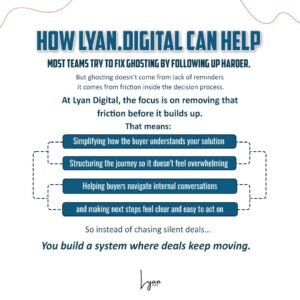
Most businesses try to fix conversion issues by tweaking pricing.
But pricing problems are often risk problems in disguise.
At Lyan Digital, the focus is on reducing perceived risk across the entire buyer journey.
That means:
- making outcomes feel clear and tangible
- simplifying how the solution is understood
- showing proof that actually feels relevant
- and structuring the process so buyers feel confident moving forward
So instead of questioning the investment…
The buyer feels comfortable making it.
Here how it helps
A service-based business kept hearing pricing objections. After simplifying how results were explained, conversions improved without changing the price.
A SaaS company had strong features but low closing rates. The issue wasn’t cost it was unclear onboarding and implementation.
A consulting firm saw prospects hesitate at the final stage. Once they addressed internal accountability and decision confidence, deals started moving faster.
Frequently Asked Question
Is pricing the main reason deals don’t close? Not always. Often, it’s a reflection of perceived risk.
How do I know if risk is the real issue? If buyers show interest but hesitate at the end, risk is likely the problem.
Should I lower prices to improve conversions? Not immediately. First, reduce uncertainty around the decision.
What kind of proof works best? Proof that feels relatable to the buyer’s situation.
How do I reduce risk perception? By increasing clarity, simplifying the process, and building decision confidence.
Pricing rarely kills a deal on its own.
It just gets blamed.
What actually stops buyers is uncertainty
about outcomes, effort, and consequences.
And until that uncertainty is reduced,
no number will feel comfortable.
But when the decision feels clear, safe, and predictable…
Price stops being the problem.
And the deal starts moving.